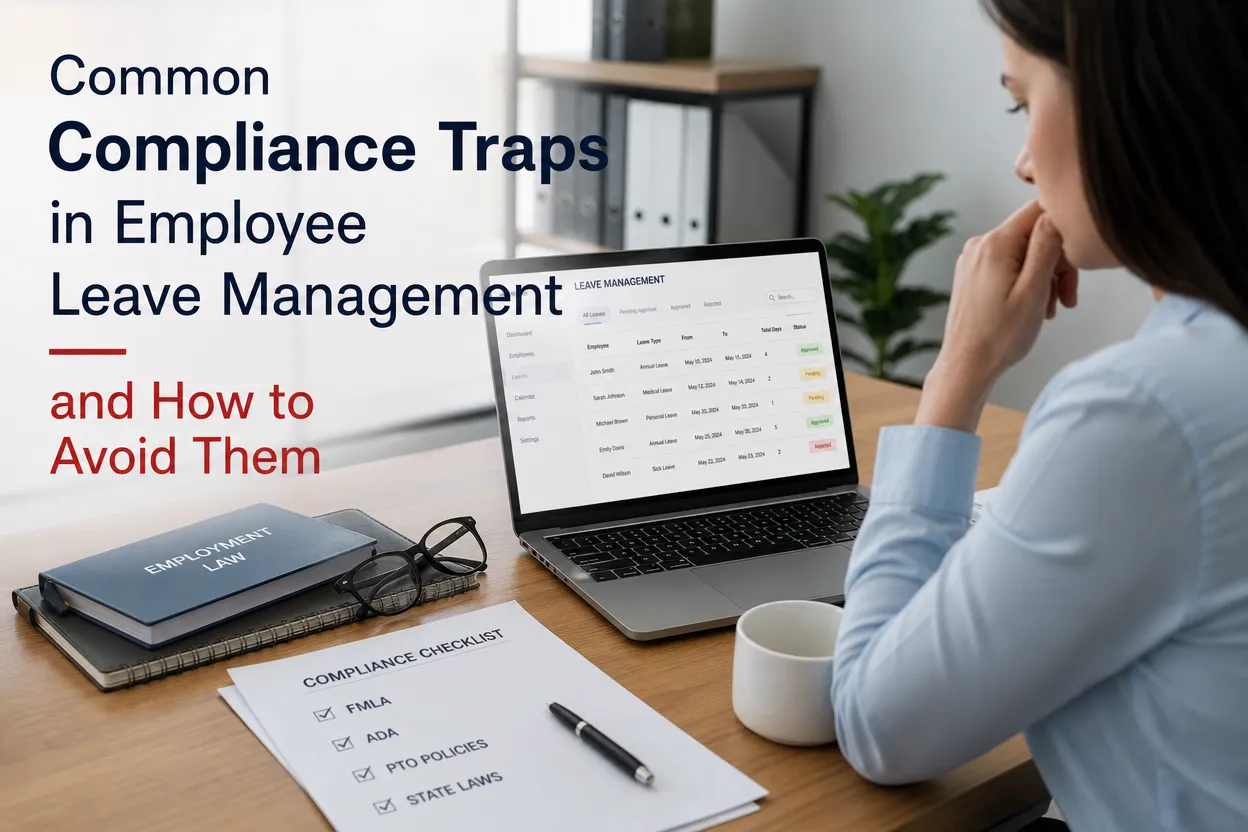
# Common Compliance Traps in Employee Leave Management and How to Avoid Them
Employee leave management plays a vital role in workplace harmony and legal compliance. Clear leave records, fair approval practices, and accurate tracking support both employees and employers. Yet many organizations face compliance issues due to gaps in policy clarity or outdated processes. These gaps often lead to disputes, payroll errors, or penalties.
A structured approach supported by [**time and attendance software**](https://www.softworks.com/time-and-attendance-tracking-software/) can simplify leave tracking and reduce compliance risks. This article explores common traps in employee leave management and explains how the right systems help avoid them.
### **Unclear Leave Policies Cause Missteps**
Leave policies that lack clarity create confusion across teams. Employees may remain unsure about eligibility, accrual limits, or approval timelines. Managers may interpret rules differently, which leads to inconsistent decisions. Clear documentation solves this issue. Policies must define leave types, approval steps, and carry-forward rules. Regular updates ensure alignment with labor laws. A centralized system makes these policies easy to access, which improves transparency across departments.
### **Inaccurate Records Invite Compliance Trouble**
Leave records serve as proof of compliance during audits or disputes. Errors in tracking can result in incorrect payroll calculations or policy violations. Manual methods increase the chance of mistakes.
Common record-related risks include:
* Incorrect leave balances due to manual entry errors
* Missing approval records or supporting documents
* No clear audit trail for policy enforcement
* Delayed updates that create confusion
Automated tracking tools reduce these risks. Accurate data ensures that every leave request aligns with company policies and legal requirements.
### **Weak Legal Awareness Leads to Violations**
Labor laws related to employee leave often change. Lack of awareness can lead to non-compliance, even when internal policies appear fair. Organizations must stay informed about statutory requirements such as sick leave, maternity benefits, and public holidays. Regular policy reviews help maintain alignment with current regulations. Expert consultation adds another layer of protection. Systems that provide compliance alerts help organizations stay updated without constant manual checks.
### **Inconsistent Approval Processes Affect Fairness**
Inconsistent leave approvals reduce [trust among employees](https://sbj.net/stories/opinion-7-tips-to-win-hearts-minds-of-employees,65609). Different managers may follow different standards, which creates dissatisfaction. A fair system requires uniform criteria for every request. Standard workflows ensure consistency. Automated approval paths guide each request through defined steps. Clear visibility into team availability helps managers make informed decisions. Fairness improves when every employee receives equal treatment under the same rules.
### **Manual Systems Slow Efficiency**
Manual processes often delay leave approvals and reduce efficiency. Paper forms or spreadsheets lack real-time updates and create extra administrative work. These limitations affect productivity and employee satisfaction.
Key challenges of manual systems include:
* Delays in leave request responses
* Limited visibility into team schedules
* Difficulty in tracking leave patterns
* Increased workload for administrative staff
Digital solutions address these challenges. Centralized platforms provide real-time data and quick access to records. This efficiency supports better workforce planning and smoother operations.
### **Technology Strengthens Compliance and Control**
A strong leave management strategy depends on reliable systems and clear communication. Advanced **time and attendance software** offers automated leave tracking, policy enforcement, and detailed reporting. These features help maintain compliance while reducing manual effort. Such systems provide real-time insights into employee availability and leave trends. Alerts for policy violations help prevent errors before they occur. Integration with payroll ensures accurate calculations, which reduces the risk of disputes.
Organizations that adopt structured processes and modern tools create a transparent and fair work environment. Clear policies, accurate records, and consistent workflows form the foundation of effective leave management. A proactive approach supports compliance, improves employee trust, and strengthens overall operational efficiency.
---
# Agent Instructions: Querying This Documentation
If you need additional information that is not directly available in this page, you can query the documentation dynamically by asking a question.
Perform an HTTP GET request on the current page URL with the `ask` query parameter:
```
GET https://eztalks.gitbook.io/blog/business/common-compliance-traps-in-employee-leave-management-and-how-to-avoid-them.md?ask=
```
The question should be specific, self-contained, and written in natural language.
The response will contain a direct answer to the question and relevant excerpts and sources from the documentation.
Use this mechanism when the answer is not explicitly present in the current page, you need clarification or additional context, or you want to retrieve related documentation sections.