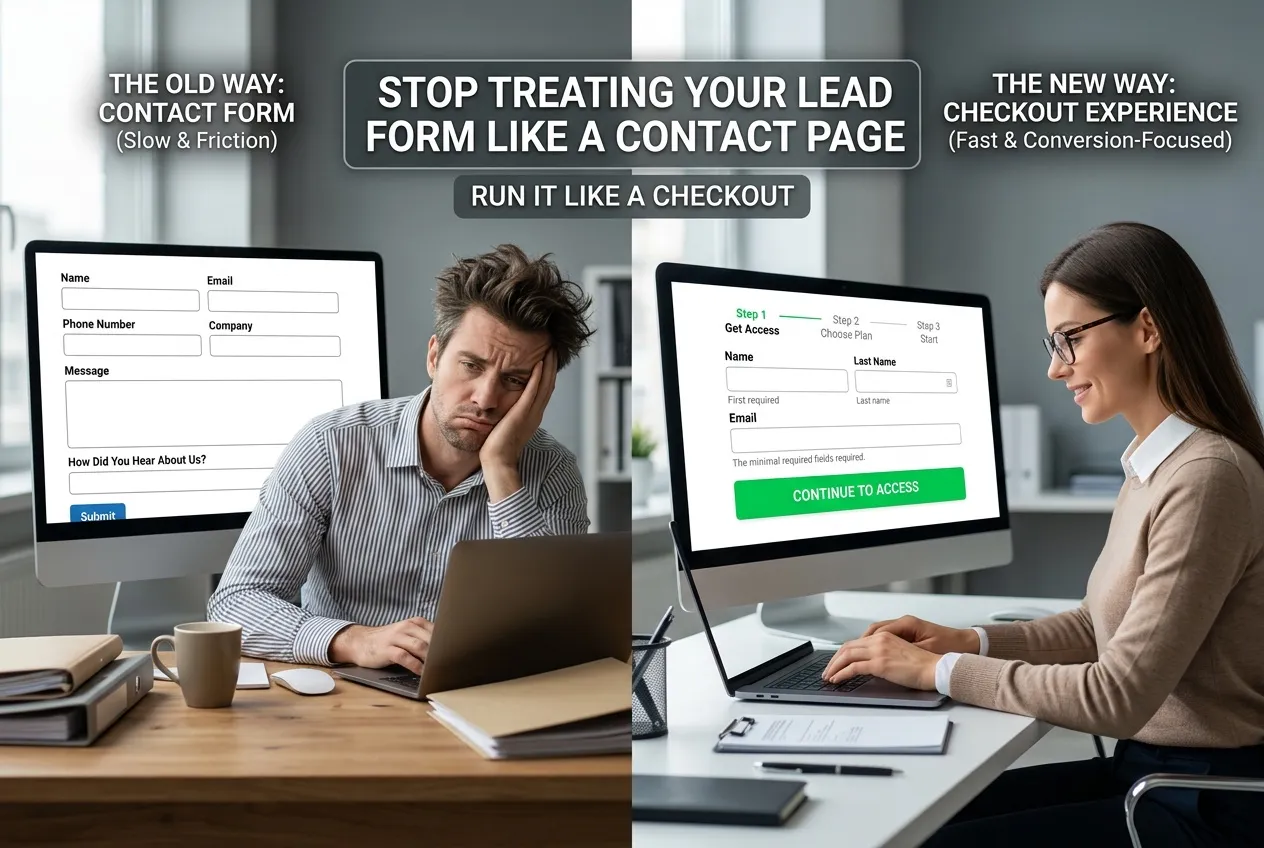
# Stop Treating Your Lead Form Like a Contact Page: Run It Like a Checkout
Most local service sites still act like brochures. They describe services, list a phone number, and hope the right person calls.
Ecommerce sites do not work that way. They remove steps, cut doubt, and measure each click that leads to cash.
If you run a private school, a pest control firm, a cleaning crew, or a service center, you sell the same thing an online store sells: a decision. Your “checkout” just looks like a form, a call, or a booked visit.
### Why service SMB sites need a checkout mindset
Friction kills sales online. It also kills leads.
Baymard’s long-running research puts average cart abandonment at about 70%. That number shocks many owners, yet the same drop-off happens on lead forms every day.
Mobile makes it worse. Google research has shown that 53% of mobile visits end if a page takes more than three seconds to load.
Local buyers also shop with doubt. BrightLocal has reported that 98% of people read online reviews for local businesses.
### Map your lead funnel like an order funnel
Start with one rule. If you cannot see the steps, you cannot fix them.
List the path from first visit to booked job or tour. Keep it plain: landing page, service page, form start, form submit, thank-you page, call, or booking.
Then tag each step in analytics. You want drop-off, not just traffic.
Tauras Sinkus, Chief Editor at EcomWatch, puts it like this: “If you can’t point to the step where most users quit, you don’t have a funnel. You have a hunch.”
#### Step 1: Treat the form as the cart
Long forms work when the user already trusts you. Most users do not.
Cut fields hard. Ask only what you need to route the lead. You can collect the rest on the call.
Match the form to the offer. A “Get a Quote” form should not ask for five items that feel like a job app.
Make the next step clear. Tell them what happens after they click, and how fast you reply.
#### Step 2: Speed, proof, and risk cut
Speed wins twice. It lifts lead rate, and it cuts paid ad waste.
Add proof next to the action. Put reviews, badges, and short results near the button, not buried on a page no one hits.
Risk cut matters for high-stakes buys like school choice. Use plain copy such as “Tour times fill fast” or “No fee for an on-site check.”
If you want hard context on online buying behavior, keep a short set of benchmarks on hand from [Ecommerce Statistics](https://ecomwatch.com/news/ecommerce-statistics/).
### Track the few numbers that move profit
Many SMB teams track page views and feel busy. Track the numbers that tie to revenue instead.
Start with lead-to-sale rate. If you close 30% of leads, one extra lead per day can mean nine more jobs a month.
Next, track cost per booked job, not cost per lead. Bad leads can look “cheap” and still crush your schedule.
Finally, track speed to first reply. Fast follow-up often beats a better pitch, since the buyer still feels the pain.
### Fixes that win fast in local markets
Private schools often send paid clicks to a general “Admissions” page. Build one page per key intent: tours, tuition help, and grade entry points.
Use one clear action per page. A tour page should push tour booking, not a long list of downloads.
Pest control and cleaning firms often lose leads after hours. Add online booking or a tight “Call me first thing” option with a time window.
Service centers should price with care. If you cannot show full price, show a real range and what sets it, so the user trusts the quote.
### When to bring in an agency
Most teams can spot obvious issues. Few can run a clean test plan while also running the business.
This work spans SEO, paid search, landing page copy, site speed, review strategy, and email follow-up. It also needs clean tracking so you can prove lift.
Cube Creative Design works in that exact mix. The team builds evidence-based plans across SEO, content writing, web design, PPC, social, email, review management, and lead gen, with case studies and awards to back it up.
If your site gets traffic but not calls, treat the fix like a checkout rebuild. Map the steps, cut the friction, and measure each change against booked work.
---
# Agent Instructions: Querying This Documentation
If you need additional information that is not directly available in this page, you can query the documentation dynamically by asking a question.
Perform an HTTP GET request on the current page URL with the `ask` query parameter:
```
GET https://eztalks.gitbook.io/blog/growth/stop-treating-your-lead-form-like-a-contact-page-run-it-like-a-checkout.md?ask=
```
The question should be specific, self-contained, and written in natural language.
The response will contain a direct answer to the question and relevant excerpts and sources from the documentation.
Use this mechanism when the answer is not explicitly present in the current page, you need clarification or additional context, or you want to retrieve related documentation sections.