# XBert AI Review: Nextiva's AI Receptionist for Small Businesses, Tested
Missing phone calls is one of those problems that sounds small until you add up what it costs. One lost call might be a new client. Five in a week might be a month's rent.
For small and mid-sized businesses, the front desk is often the weakest link. Staff are stretched thin. Hours are limited. And voicemail does not close deals.
That is exactly the gap an[ AI receptionist](https://www.nextiva.com/x/xbert-assistant-ai-respona?utm_source=respona\&utm_medium=review-ad\&utm_campaign=xbert-respona\&utm_content=review-xbert\&utm_term=aireceptionist) is designed to fill. It picks up the phone when your team cannot, handles basic requests and passes the rest along. In this review, we look at XBert AI from Nextiva to see whether its AI receptionist actually delivers on that promise.
### **What XBert AI Does**
XBert is an AI receptionist built by Nextiva. It answers phone calls, text messages and web chats around the clock using [voice technology](https://en.wikipedia.org/wiki/Speech_synthesis) that sounds like a real person.
When someone calls your business, XBert picks up right away. It greets the caller, answers common questions, books or reschedules appointments and captures their contact details.
If the caller needs to speak with someone on your team, XBert transfers the call. The person on the other end gets a quick summary of what was already discussed so nothing gets repeated.
It is not trying to be your entire customer service department. It is built to catch the calls that would otherwise go to voicemail or get missed completely.
### **Why Small Businesses Need This**
The numbers tell a clear story. Research shows more than 60% of calls to small businesses go unanswered. That is not a technology problem. It is a staffing one.
Most small teams cannot be on the phone and do their work at the same time. A plumber is under a sink. A dentist is with a patient. A solo consultant is on a Zoom call.
After-hours calls are another gap. Customers do not stop needing things at 5 PM. If your phone goes to voicemail on a Friday evening, there is a good chance that the caller is booking with your competitor by Monday morning.
High call volume during peak periods creates the same issue. Even businesses with a front desk person can only handle one call at a time. When three calls come in at once, two go unanswered.
XBert is built to sit in that gap and make sure no call gets dropped. For businesses already working to streamline their internal workflows, tools like these complement the broader shift toward smarter communication systems. If your team already relies on platforms that unify messaging and collaboration, such as those explored in this guide to multi-channel business messaging, adding an AI receptionist to handle the external-facing side of things is a natural next step.
### **Key Features Worth Knowing About**
**XBert is not just a glorified voicemail system.** It has a real feature set that covers the most common needs of a busy small business.
**Always-on call answering.** XBert picks up every inbound call instantly. It handles multiple calls at the same time, which means no hold music and no busy signals even during your busiest hours.
**Text and chat support.** Customers can also reach your business through SMS or your website chat. XBert manages those channels too, so you are not juggling three different tools.
**Appointment booking.** It connects with your calendar to schedule, confirm and move appointments in real time. Automated reminders go out to cut down on no-shows.
**Lead capture and qualification.** XBert collects caller information and filters it based on rules you set. Your team gets organized leads, not a random pile of messages.
**Call transfers with context.** When a caller needs a human, XBert routes the call to the right person. That person sees a short summary of the conversation before they pick up.
**Dashboard and transcripts.** Every interaction gets logged and transcribed. You can review call volume, spot trends and see what questions come up most without listening to hours of recordings.
None of these features are revolutionary on their own. But bundled together at this price point, they cover a lot of ground.
### **Getting Started**
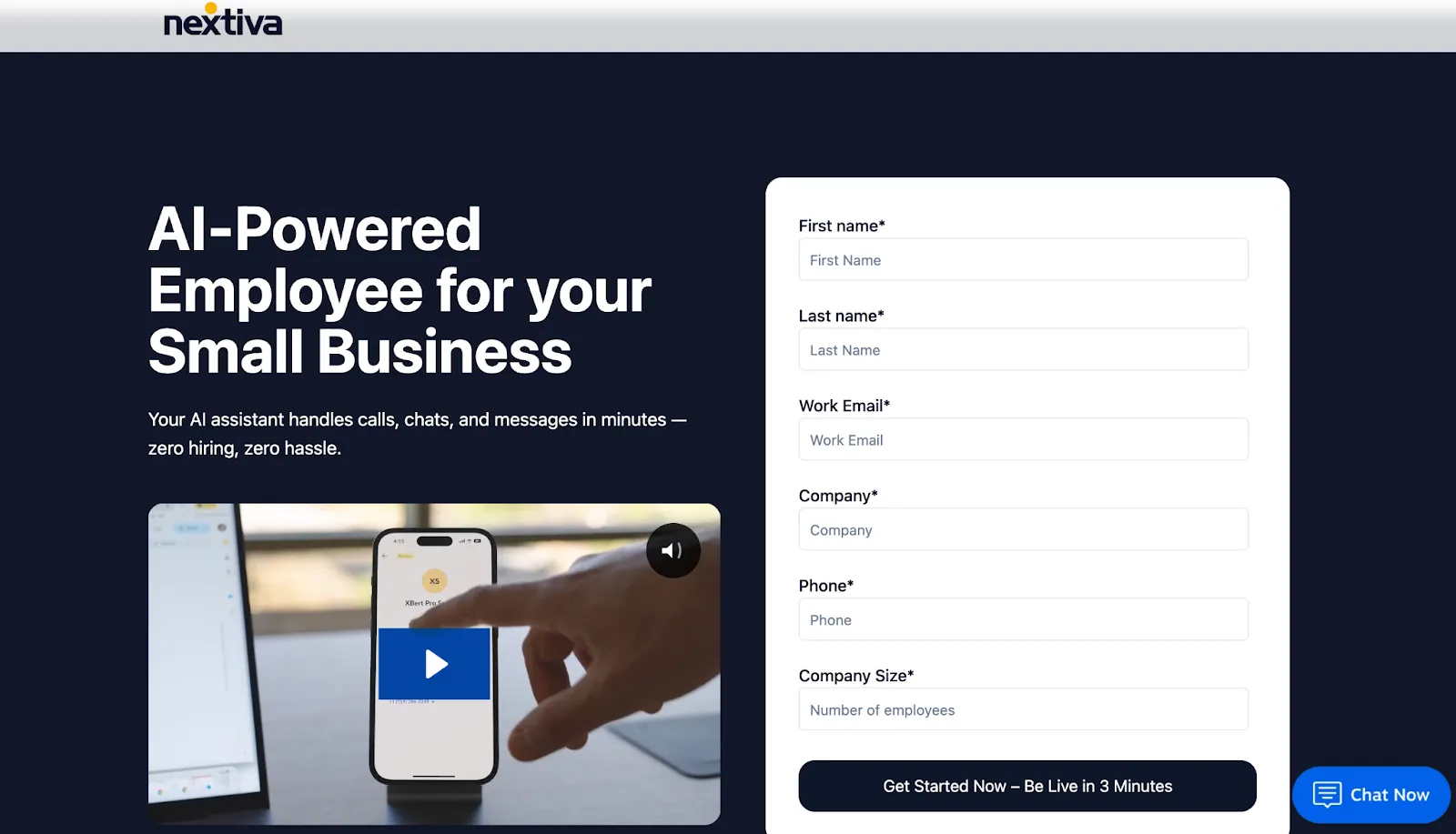
Setup is one of XBert's strongest points. Nextiva says most businesses go live in under three minutes, and from what users report, that checks out.
You fill in some details about your business. You pick a voice for your receptionist. You set your greeting and call routing rules. XBert then scans your website to learn about your services and build its own knowledge base.
If you would rather not do it yourself, Nextiva offers free white-glove onboarding. Their team handles the configuration, tests your call flows and adjusts responses before you start taking real calls.
That is a nice touch. Many business owners are not technical, and having someone walk you through it removes the biggest barrier to actually using the tool.
### **Where XBert Fits in the Real World**
**XBert is not built for one type of business.** It works across a range of industries, but some get more out of it than others.
**Trades and service providers.** Plumbers, electricians and HVAC techs spend their days on job sites. They cannot answer the phone while working, but they also cannot afford to miss a call from a homeowner with a burst pipe. XBert catches those calls, logs the details and books the job.
**Clinics and medical offices.** Front desk staff in healthcare are often swamped. XBert handles [appointment scheduling](https://eztalks.com/blog/ai/5-top-ai-tools-to-manage-appointments-for-service-based-businesses), answers basic insurance questions and sorts calls so urgent ones get through fast.
**Law firms and financial advisors.** In professional services, a missed call from a potential client can mean thousands in lost fees. XBert gives every caller a prompt, professional first response and routes qualified leads to the right person.
**Agencies and local businesses.** Marketing agencies, real estate offices, salons and retail shops all deal with the same problem. Calls come in when staff are tied up. XBert keeps those conversations going even when nobody is at the desk.
The thread connecting all of these is simple. If your business makes money from inbound calls, missing them costs you.
### **What It Costs**
XBert is $99 per month. That includes 100 conversations. Every conversation after that is $0.99. No long-term contracts. Nextiva includes a 30-day money-back guarantee.
A full-time receptionist costs somewhere between $38,000 and $60,000 per year when you factor in salary, benefits and training. XBert covers nights, weekends, holidays and overlapping calls for roughly $1,200 to $2,400 per year depending on how many calls you take.
The savings are real. But the per-conversation pricing can sneak up on businesses with heavy phone traffic. If your call volume is high and unpredictable, run the numbers before you sign up.
### **XBert vs. Hiring a Live Receptionist**
This is the comparison every business owner runs in their head, so it is worth spelling out.
A human receptionist brings something XBert cannot. They read emotions, adapt their tone and handle messy situations with care. For calls that involve complaints, sensitive topics or upset customers, a real person still wins.
XBert wins everywhere else. It works 24/7, handles multiple calls at once, never gets tired and treats every caller the same way. It does not need sick days, training time or a benefits package.
The best setup for most small businesses is a mix. Let XBert handle the volume, the after-hours calls and the routine questions. Save your team for the calls that actually need a human.
### **What This Looks Like in Practice**
Imagine a small plumbing company. Two people. The owner and one tech, out on jobs from 7 AM to 6 PM.
Calls come in all day. Neither of them can pick up while they are working. Without XBert, those calls go to voicemail. A few people leave a message. Most hang up and call someone else.
With XBert, every call gets answered on the first ring. The system asks whether it is an emergency or a routine request. Non-urgent jobs get booked. Emergency calls get flagged and forwarded.
At the end of the day, the owner has a list of booked jobs and new leads with full details instead of ten voicemails to return after dinner. That is a real difference.
### **What Works Well**
There is a lot to like here if you have been losing calls to voicemail.
The voice quality is good. Callers often do not realize they are talking to a machine, which matters more than most people think. A robotic voice kills trust fast.
Setup is genuinely quick. The white-glove option takes the stress out of it if you are not comfortable with tech. Multi-channel support across calls, texts and chat is a plus because it keeps everything in one place.
CRM and calendar integrations work smoothly. And the price is hard to beat compared to any human staffing option.
If you are already a Nextiva customer, turning XBert on takes almost no effort at all.
### **Where It Falls Short**
XBert is not the right tool for every situation. Here is where it runs into limits.
Difficult conversations are still a gap. If a caller is upset, confused or dealing with something emotional, the experience will feel different than talking to a person. That matters in industries like healthcare, legal and financial services.
The product is closely tied to Nextiva's ecosystem. If you are not already using Nextiva, you may end up adopting more of their platform than you originally wanted just to get the full benefit.
Per-conversation pricing is transparent, but it can climb fast during busy stretches. Flat-rate providers might offer more predictable costs for high-volume businesses.
XBert is also still building its reputation as a standalone product. User reviews are positive so far, but there are not many of them yet compared to tools that have been around longer.
### **Who Should Consider XBert**
Small and mid-sized businesses that depend on inbound calls and cannot afford to keep missing them. That is the core audience.
Trades, clinics, agencies, law firms, local shops and service providers with anywhere from one to fifty employees will see the fastest payoff. If your current system is voicemail or a personal cell phone, XBert is a clear upgrade.
It also works well for businesses that want evening and weekend coverage without hiring for those hours.
### **Who Should Probably Look Elsewhere**
Larger companies with dedicated call centers need more than what XBert offers. Businesses that mostly make outbound calls will not get much value from an inbound-focused tool.
If you work in a heavily regulated industry, confirm that XBert meets your specific compliance requirements before committing. And if nearly every call you take involves sensitive or high-stakes conversation, a trained human receptionist should still be your first choice.
### **Final Verdict**
XBert AI solves a real, costly problem. Missed calls mean missed revenue, and for most small businesses, that problem only gets worse as they grow.
The tool is easy to set up, sounds natural on the phone and covers calls, texts and chats for a fraction of what a human hire would cost. It is not perfect for every scenario, but it does not need to be.
If inbound calls matter to your business and too many of them are going unanswered, XBert is worth trying. The 30-day guarantee makes it low risk. The potential upside is hard to ignore.
---
# Agent Instructions: Querying This Documentation
If you need additional information that is not directly available in this page, you can query the documentation dynamically by asking a question.
Perform an HTTP GET request on the current page URL with the `ask` query parameter:
```
GET https://eztalks.gitbook.io/blog/ai/xbert-ai-review-nextivas-ai-receptionist-for-small-businesses-tested.md?ask=
```
The question should be specific, self-contained, and written in natural language.
The response will contain a direct answer to the question and relevant excerpts and sources from the documentation.
Use this mechanism when the answer is not explicitly present in the current page, you need clarification or additional context, or you want to retrieve related documentation sections.