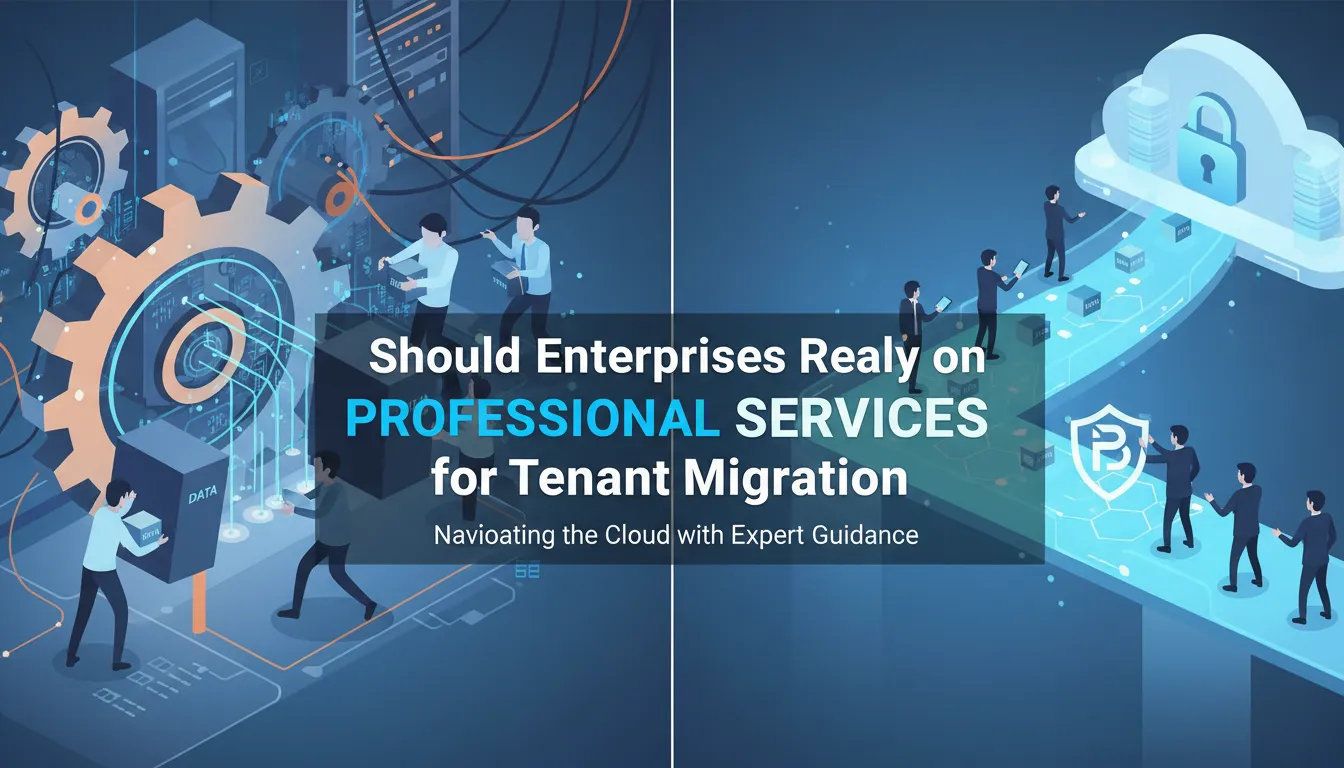
# Should Enterprises Rely on Professional Services for Tenant Migration
Enterprises continue to reshape digital environments to support collaboration, agility, and long-term growth objectives. Tenant migration represents a pivotal step because it affects users, data, and operational continuity at scale. Decision makers often evaluate whether expert cloud migration services justify the investment during this transition.
Many enterprises review frameworks, such as[ Office 365 tenant migration best practices](https://www.o365cloudexperts.com/blog/tenant-to-tenant-migration-in-office-365/), to visualize an effective tenant move. These examples clarify sequencing, validation points, and communication structure across teams. When organizations treat such frameworks as guidance examples, professional migration services appear as a natural extension.
### Strategic Evaluation and Direction
Professional cloud migration services begin with a detailed evaluation of the current tenant environment. Specialists review users, workloads, security controls, and technical dependencies across platforms. This evaluation provides clarity that supports confident planning and alignment. Based on these insights, experts define a clear migration direction and structured roadmap. The roadmap outlines phases, priorities, and measurable success criteria.
Enterprises benefit from shared understanding across technical teams and leadership. Risk factors and compliance considerations receive early attention to prevent downstream disruptions. Capacity forecasts help ensure infrastructure readiness throughout each migration stage.
### Data Protection and Business Continuity
Tenant migration requires careful handling of enterprise data across multiple services. Professional migration services apply proven methods that protect accuracy and completeness during transfer. These methods support uninterrupted access to critical resources. Validation steps follow each migration phase to confirm expected results. Access permissions, mail flow, and collaboration tools receive close review.
This disciplined approach reinforces trust and operational stability. Detailed reporting provides stakeholders with clear visibility into progress and outcomes. Structured rollback plans further safeguard business continuity if unexpected issues arise.
### Security and Governance Alignment
Security and governance requirements shape enterprise cloud strategies. Professional cloud migration services align tenant transitions with internal policies and regulatory expectations. Each security configuration receives deliberate review throughout the process. Identity controls and audit settings move under controlled conditions.
Specialists verify governance consistency within the new tenant environment. Enterprises retain confidence in oversight and compliance posture. Continuous monitoring frameworks support early detection of policy deviations. Documentation updates ensure long-term audit readiness and accountability.
### Efficient Use of Internal Resources
Internal IT teams often manage numerous strategic and operational responsibilities. Professional migration services handle technical execution and cross-team coordination. This support allows internal teams to maintain focus on core initiatives.[ ](https://www.businessscotlandmagazine.com/improving-employee-productivity)[Employee productivity](https://eztalks.com/unified-communications/10-ways-to-increase-employee-productivity.html) improves through established tools and standardized processes. Experts execute tasks with precision and consistency across migration phases.
Enterprises achieve predictable timelines with minimal internal disruption. Knowledge transfer sessions strengthen internal capability after project completion. Clear communication frameworks reduce confusion and accelerate decision-making during transitions.
### User Experience and Communication
User experience plays a critical role in tenant migration success. Professional services emphasize clear communication and structured user guidance. Users receive timely updates that support readiness and confidence. Support continues after the tenant transition completes. Specialists address access updates, configuration questions, and optimization needs. This attention helps users adapt quickly and sustain productivity. Training resources assist users in dealing with updated environments with ease. Feedback mechanisms capture user insights to refine post-migration support strategies.
### Scalability and Long-Term Value
Professional cloud migration services design tenant environments with future requirements in mind. Architecture choices support growth, integration, and performance improvement over time. This foresight aligns the technology structure with the business direction. After migration, optimization efforts refine configuration and usage patterns. Enterprises gain insight into efficiency opportunities and collaboration improvements.
These benefits extend value beyond the initial tenant move. Cost management analysis identifies opportunities for smarter resource allocation. Scalable governance models prepare the tenant for changing organizational demands.
### Vendor Accountability and Risk Management
Professional cloud migration services introduce defined accountability into complex tenant transitions. Service providers operate under contractual scopes, service level commitments, and documented responsibilities. This structure reduces ambiguity around ownership of tasks, timelines, and outcomes. Enterprises gain reassurance through clear escalation paths and issue resolution protocols.
Risk management benefits from this accountability model throughout the migration lifecycle. Specialists anticipate technical and operational risks based on prior enterprise engagements. Preventive controls and contingency planning reduce exposure to unexpected disruptions. Leadership teams gain confidence through transparent reporting and measurable progress checkpoints.
### Change Management and Adoption Measurement
Tenant migration success extends beyond technical completion into behavioral adoption across the enterprise. Professional cloud migration services support structured change management that prepares teams for new workflows and operational patterns. Communication plans align leadership messaging with practical user expectations. This preparation reduces resistance and improves engagement during transition phases.
Adoption measurement provides insight after the tenant move concludes. Specialists track usage trends, collaboration behaviors, and feature adoption across departments. These metrics reveal where additional guidance or refinement may be required. Enterprises gain clarity on return value while strengthening long-term platform adoption.
For instance, Office 365 tenant migration best practices often demonstrate how structured expertise supports successful tenant transitions. Professional cloud migration services offer reliable execution through planning, security alignment, and user focus. Enterprises that rely on expert support achieve stable, scalable tenant environments that enable sustained digital progress.
---
# Agent Instructions: Querying This Documentation
If you need additional information that is not directly available in this page, you can query the documentation dynamically by asking a question.
Perform an HTTP GET request on the current page URL with the `ask` query parameter:
```
GET https://eztalks.gitbook.io/blog/tech/should-enterprises-rely-on-professional-services-for-tenant-migration.md?ask=
```
The question should be specific, self-contained, and written in natural language.
The response will contain a direct answer to the question and relevant excerpts and sources from the documentation.
Use this mechanism when the answer is not explicitly present in the current page, you need clarification or additional context, or you want to retrieve related documentation sections.