# From Lyrics to Melody: How Song Generator AI Turns Ideas into Full Tracks
The music industry is experiencing a technological revolution that's democratizing music creation like never before. Song Generator AI systems are transforming how we approach composition, allowing anyone to create complete musical tracks from simple lyrical ideas or text prompts. These sophisticated tools bridge the gap between musical vision and technical execution, making music production accessible to creators regardless of their formal training or instrumental skills.
### Understanding How Song Generator AI Works
AI song generators represent a breakthrough in creative technology, combining natural language processing, machine learning, and music theory to transform text into fully realized musical compositions. But how exactly does this process work? Let's break down the journey from input to finished track.
#### Step 1: Input Methods and Initial Processing
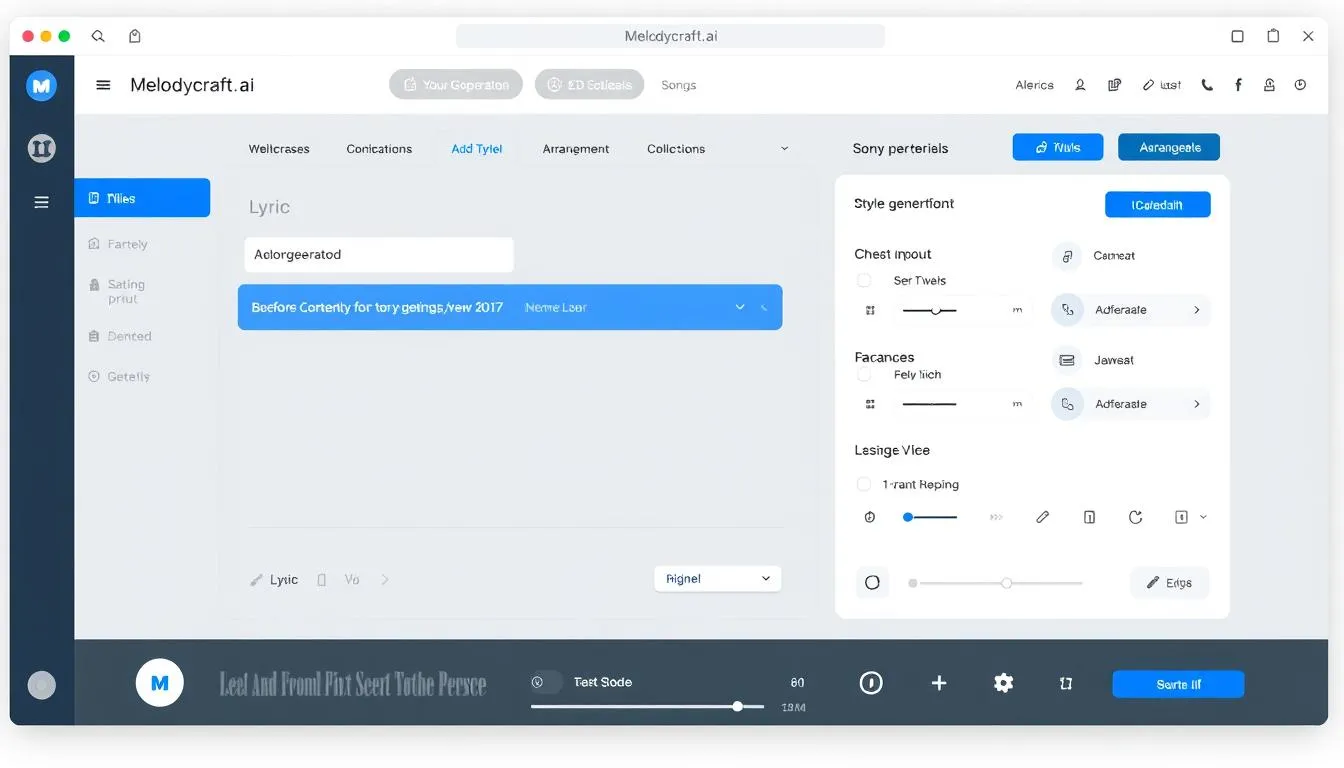
The journey begins with your input.[ Song Generator AI platforms](https://melodycraft.ai/) offer multiple ways to start the creative process:
Text prompts - Describe the style, mood, and elements you want in your track
Direct lyric input - Paste complete lyrics for the AI to set to music
Mood selection - Choose emotional qualities to guide the composition
Genre specifications - Direct the AI toward specific musical styles
Once you provide input, the AI's natural language processing system analyzes your text. It identifies key descriptors, emotional cues, and structural elements to understand your creative intent. This semantic analysis forms the foundation for all subsequent musical decisions.
#### Step 2: Melody Generation and Harmonic Structure
With your input analyzed, the AI begins the core musical creation process. The melody generation algorithms construct the primary musical themes based on the mood, genre, and lyrical content provided. These algorithms have been trained on thousands of songs across various genres to understand what makes melodies catchy, emotional, or suitable for specific contexts.
Simultaneously, the system develops a harmonic structure that complements the melody. This includes:
* Chord progressions that support the emotional quality of the lyrics
* Key selection appropriate to the vocal range implied by the content
* Harmonic rhythm that matches the pacing of the lyrics
* Tonal variations that create interest throughout different song sections
#### Step 3: Rhythm and Beat Pattern Development
The rhythmic foundation of your track comes next. The AI analyzes the natural cadence of your lyrics or the descriptive elements in your prompt to determine appropriate tempo and rhythmic patterns. It considers:
* Tempo selection based on mood and genre specifications
* Beat patterns that match lyrical flow and emphasis
* Rhythmic complexity appropriate to the style
* Percussion and rhythmic element selection
For example, a prompt describing "an upbeat summer dance track" would trigger algorithms that generate faster tempos and energetic rhythmic patterns, while "a melancholic piano ballad" would result in slower, more fluid rhythmic structures.
#### Step 4: Instrumentation and Arrangement
With the melodic, harmonic, and rhythmic foundations in place, the AI moves to instrumentation and arrangement. This stage involves:
* Selecting appropriate instruments based on genre and mood
* Creating complementary instrumental parts that support the melody
* Developing intro, verse, chorus, bridge, and outro sections
* Balancing the mix for professional sound quality
* Adding production elements like reverb, delay, and other effects
The arrangement process is particularly sophisticated, as it requires understanding how different sections of a song typically flow together. The AI has been trained on song structures across genres to create natural-sounding progressions between sections.
### Transform Your Ideas Into Songs Today
Experience the power of AI music creation with Melodycraft.ai. Turn your lyrics or simple ideas into professionally produced tracks in minutes, no musical experience required.
### The Technology Behind Song Generator AI
The impressive capabilities of modern Song Generator AI systems are built on sophisticated technological foundations that combine multiple disciplines in artificial intelligence and music theory.
#### Neural Networks and Deep Learning
At the core of Song Generator AI are complex neural networks trained on vast datasets of music. These networks learn patterns in melody, harmony, rhythm, and structure across different genres and styles. The most advanced systems use:
* Transformer architectures - Similar to those used in language models, adapted for musical sequences
* Convolutional neural networks - For pattern recognition in musical elements
* Recurrent neural networks - To understand temporal relationships in music
* Generative adversarial networks - To create and refine musical outputs
#### Music Theory Implementation
While neural networks provide the learning capability, explicit music theory rules are often incorporated to ensure musical coherence. These include:
* Rules for chord progressions and voice leading
* Principles of melodic development and resolution
* Guidelines for rhythmic consistency and variation
* Structural templates for different song formats
The combination of learned patterns and explicit rules allows Song Generator AI to create music that sounds natural and follows established musical conventions while still being original.
#### Audio Synthesis and Production
The final technological component involves turning the musical data into actual sound. Advanced systems like Melodycraft.ai use sophisticated audio synthesis and virtual instrument modeling to create realistic instrumental and vocal performances. They also apply automated mixing and mastering techniques to produce professional-quality audio output.
### Creative Possibilities and Limitations
Song Generator AI opens up remarkable creative possibilities while also having certain limitations that are important to understand.
#### Creative Possibilities
● Rapid prototyping of musical ideas
● Exploration of unfamiliar genres and styles
● Overcoming creative blocks with AI suggestions
● Creating backing tracks for live performance
● Developing music without instrumental skills
#### Current Limitations
● Nuanced emotional expression can be challenging
● Highly experimental music may be difficult to generate
● Some genre-specific techniques may be limited
● Unique artistic signatures require human refinement
● Complex narrative development needs guidance
#### Finding the Balance: AI Assistance and Human Creativity
The most effective approach to Song Generator AI is viewing it as a collaborative tool rather than a replacement for human creativity. Professional musicians and producers often use these tools to:
* Generate initial ideas that they then refine and develop
* Create backing tracks that they enhance with live performances
* Explore alternative arrangements of existing compositions
* Quickly produce demo versions to test concepts
This collaborative approach leverages the strengths of both AI (speed, technical execution, pattern recognition) and human creativity (emotional nuance, artistic vision, cultural context).
### Practical Examples: From Prompt to Song
To better understand how Song Generator AI transforms input into music, let's examine how different prompts might generate varied musical results.
#### Emotional Ballad
Input prompt: "A heartfelt piano ballad about lost love with emotional female vocals"
AI response: The system would likely generate a slow-tempo composition in a minor key, featuring prominent piano arpeggios, sparse percussion, and a melody designed for female vocal range with longer, sustained notes to convey emotion.
#### Upbeat Pop Track
Input prompt: "An energetic summer pop song with tropical house influences and catchy chorus"
AI response: This would trigger generation of a faster tempo track with bright major chords, electronic dance beats with tropical percussion elements, and a repetitive, hook-focused chorus melody designed for memorability.
#### Hip-Hop Production
Input prompt: "A modern trap beat with dark piano melody and space for rap verses"
AI response: The AI would create a composition with prominent 808 bass, trap hi-hat patterns, minimal but atmospheric piano motifs, and clear section differentiation between verse and chorus areas with space for vocals.
#### Lyric-Based Generation Example
When providing complete lyrics rather than descriptive prompts, the AI analyzes the text for emotional content, natural rhythm, and thematic elements. For example:
I've walked these streets in the pouring rain\
Searching for something I can't explain\
Every corner holds a memory\
Of what we had and what could be
The AI would identify the melancholic tone, analyze the syllable patterns for natural rhythm, and likely generate a mid-tempo composition with emphasis on the emotional qualities implied by the lyrics. The melody would follow the natural speech patterns of the text while enhancing emotional moments.
### Melodycraft.ai: Innovative Features in AI Music Creation
Among the various Song Generator AI platforms available today, Melodycraft.ai stands out with several innovative approaches to AI-powered music creation. Its advanced algorithms specifically excel at maintaining the emotional intent behind user inputs while producing professionally arranged compositions.
Emotional mapping technology - Analyzes lyrical content for emotional cues and translates them into appropriate musical elements
Genre-adaptive learning - Continuously updates its understanding of genre conventions based on contemporary music trends
Collaborative editing tools - Allows users to refine AI-generated compositions with intuitive controls
Multi-track export - Provides separate instrumental and vocal tracks for further editing in DAWs
These capabilities make Melodycraft.ai particularly valuable for songwriters looking to quickly prototype ideas, content creators needing original music, and musicians exploring new creative directions.
### The Future of AI in Music Creation
As Song Generator AI technology continues to evolve, we can anticipate several important developments that will further transform music creation:
Increased stylistic precision - Future systems will offer even more nuanced control over specific sub-genres and stylistic elements
**Enhanced emotional intelligence** - AI will become better at capturing and expressing subtle emotional qualities in music
**Improved vocal synthesis** - More realistic and expressive AI vocals will blur the line between human and synthetic performances
**Adaptive composition** - AI music that can change dynamically based on context (for games, interactive media, etc.)
**Collaborative co-creation** - More sophisticated tools for human-AI creative partnership
These advancements will continue to democratize music creation, allowing more people to express themselves musically regardless of technical training. However, they also raise important questions about creativity, authorship, and the evolving relationship between human artists and AI tools.
### Conclusion: A New Era of Musical Creation
Song Generator AI represents a significant shift in how we approach music creation. By breaking down the technical barriers that have traditionally limited musical expression, these tools are opening creative possibilities to a much wider audience. From professional musicians seeking inspiration to content creators needing original soundtracks, the technology offers valuable solutions across the creative spectrum.
As with any transformative technology, the most exciting developments will likely come from how humans choose to incorporate these tools into their creative processes. Rather than replacing human creativity, Song Generator AI seems poised to enhance it, providing new avenues for expression and collaboration between human and machine intelligence.
#### Ready to Create Your Own Music?
Experience the power of AI-assisted music creation with Melodycraft.ai. Transform your ideas into fully-realized songs today, no musical experience required.
---
# Agent Instructions: Querying This Documentation
If you need additional information that is not directly available in this page, you can query the documentation dynamically by asking a question.
Perform an HTTP GET request on the current page URL with the `ask` query parameter:
```
GET https://eztalks.gitbook.io/blog/ai/from-lyrics-to-melody-how-song-generator-ai-turns-ideas-into-full-tracks.md?ask=
```
The question should be specific, self-contained, and written in natural language.
The response will contain a direct answer to the question and relevant excerpts and sources from the documentation.
Use this mechanism when the answer is not explicitly present in the current page, you need clarification or additional context, or you want to retrieve related documentation sections.