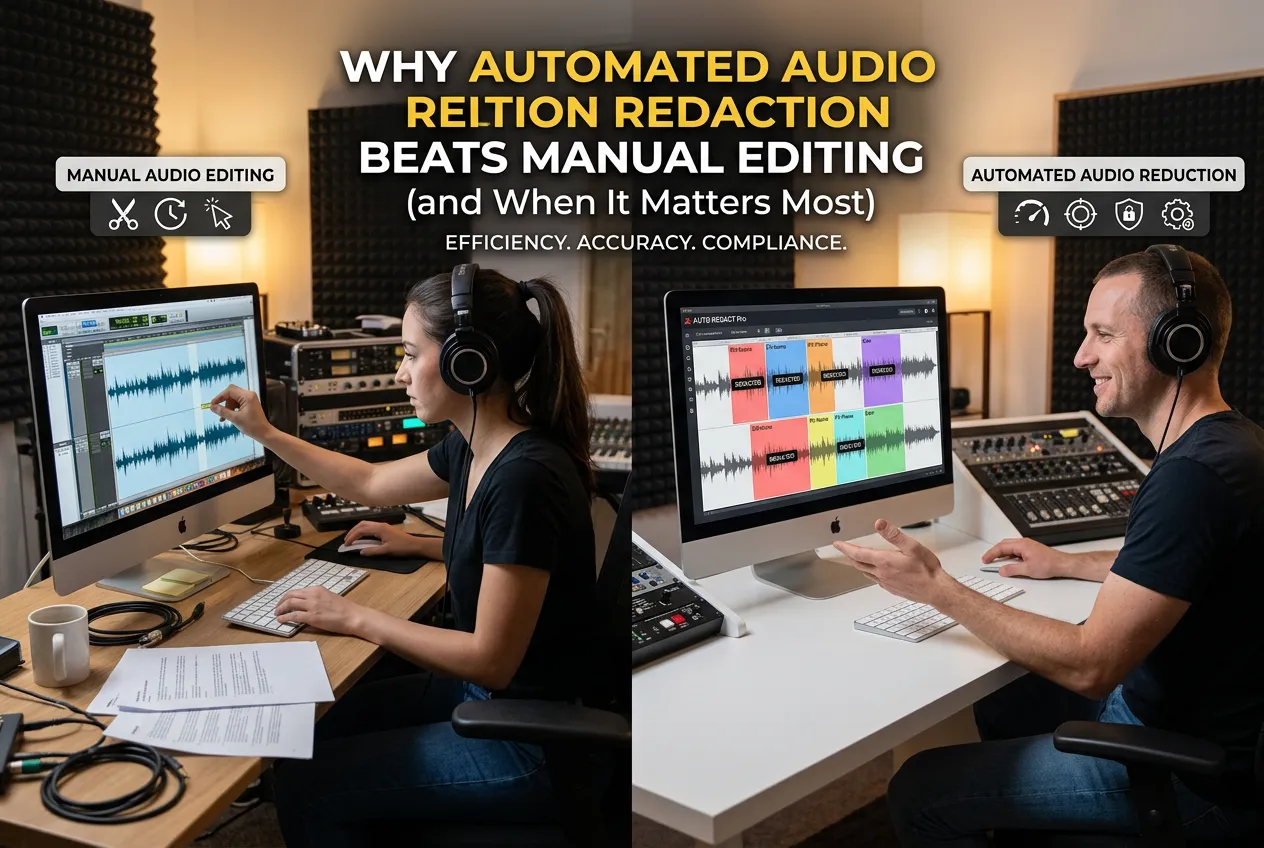
# Why Automated Audio Redaction Beats Manual Editing (and When It Matters Most)
Anyone who’s ever had to redact audio for disclosure knows the uncomfortable truth: the work isn’t hard because it’s complicated—it’s hard because it’s *relentless*. Hours of interviews, body-worn camera clips, jail calls, and dispatch recordings quickly turn into a backlog that never really goes away. Meanwhile, public records deadlines don’t care that you’re short-staffed, and prosecutors don’t want surprises late in discovery.
Manual redaction can feel like the “safest” route because you’re listening to every second yourself. But in practice, the more you rely on humans to do repetitive, high-stakes edits under time pressure, the more you invite inconsistency. Automated audio redaction isn’t just about speed; it’s about building a process that holds up when volume spikes, when staff changes, and when the same file will be scrutinized months later in court.
### **The Real Problem With Manual Audio Redaction: Scale**
Manual workflows were built for a world where recordings were scarce. That’s not today’s reality. Modern agencies create audio constantly—often in parallel across units—and a single case can involve multiple sources and formats.
If you’re trying to evaluate options or set expectations internally, it helps to look at how purpose-built approaches handle law enforcement constraints. This overview of[ solutions for redacting speech in police evidence](https://www.secureredact.ai/articles/audio-redaction-for-law-enforcement) is a useful reference point because it frames redaction as an evidence-handling problem, not just an editing task.
#### **Time cost isn’t linear—it compounds**
With manual editing, each additional hour of audio doesn’t just add an hour of work. It adds review time, QA time, export time, versioning, and often rework when someone spots a missed identifier. In real operations, that means one high-profile incident can monopolize staff attention and slow everything else down.
A common failure mode looks like this: an analyst redacts the obvious personal data, sends the file onward, then a supervisor requests “one more pass” for context-dependent identifiers—names referenced obliquely, a phone number spoken quickly, a minor’s school, a medical detail. Each pass increases both turnaround time and the probability that changes are applied inconsistently across versions.
#### **Human accuracy degrades in predictable ways**
Even excellent staff are still human. Fatigue and cognitive load show up as:
* missed words at natural breaks (cross-talk, laughter, radio chirps)
* inconsistent judgment calls (“Does that count as an identifier in this jurisdiction?”)
* timing errors where the beep starts late or ends early, exposing a syllable that matters
Manual redaction also tends to be “craft-based.” Two people, two slightly different results—even with the same policy. That’s a governance problem, not a skills problem.
### **What Automated Redaction Changes (Beyond Speed)**
Automation is often framed as a shortcut. In redaction, it’s better understood as *standardization*—a way to apply the same rules consistently, then document what happened.
#### **Speech-aware redaction targets what actually needs to be removed**
Audio redaction isn’t like blurring a face. You’re managing spoken language: names, addresses, medical info, account numbers, and sometimes contextual identifiers that only become sensitive when paired with other facts.
Well-designed automated systems typically rely on some combination of speech-to-text, entity detection, and time-aligned masking. The practical advantage is that you can search and flag likely sensitive terms across long recordings quickly, then focus human attention where it’s actually needed.
This leads to a healthier division of labor: the machine does the scanning and first-pass marking; the human makes the final call on nuance and policy.
#### **You get repeatable, auditable outputs**
When disclosure decisions are questioned, “I listened carefully” is not a satisfying process defense. What reviewers want is a traceable path: what was identified, what was removed, what was left, and why.
Automation makes it easier to generate logs of redaction events (timestamps, categories, confidence markers, reviewer notes). That doesn’t replace legal judgment, but it does make your workflow legible to supervisors, counsel, and—when necessary—courts.
### **Quality and Defensibility: The Part People Underestimate**
The best argument for automation isn’t that it’s faster. It’s that it’s *more defensible* when implemented thoughtfully.
#### **Consistency is a legal risk reducer**
Inconsistent redaction creates avoidable headaches:
* One clip hides a witness name; another clip from the same event leaves it audible.
* A juvenile is protected in one segment, but not in the follow-up interview.
* A medical detail is bleeped in the primary file, yet appears unmasked in an “exported for review” version.
These gaps are rarely malicious—they’re workflow artifacts. Automated pipelines reduce them by applying the same detection logic and the same masking rules across a batch, then letting reviewers validate exceptions.
#### **Chain-of-custody thinking matters for audio, too**
Redaction should be treated like evidence handling: controlled access, version control, and clear separation between original and released copies. Manual editing on desktops, copied files, and ad hoc exports can turn into an audit nightmare.
Automation encourages better hygiene: centralized processing, permissions, and reproducible exports. If someone asks, “Which version did we release on that date?” you shouldn’t have to reconstruct the answer from email threads.
### **How to Adopt Automated Redaction Without Creating New Problems**
Automation isn’t magic. It needs policy alignment, careful thresholds, and a workflow that respects edge cases.
#### **A practical rollout approach**
If you’re evaluating or piloting automation, keep the scope narrow at first and define success clearly. One effective starting point is high-volume, lower-nuance material (for example, routine calls) before moving into complex interviews.
Here’s a simple checklist to keep implementation grounded (and to avoid the “set it and forget it” trap):
* Define categories to redact (PII, juveniles, medical, informant indicators) in writing
* Decide what requires mandatory human review vs. spot checks
* Set confidence thresholds and escalation rules for ambiguous matches
* Require a redaction log and versioning for every exported file
* Run parallel tests: manual vs. automated + review, then compare errors and time
#### **Keep humans in the loop where judgment is required**
Automation is strongest at detection and repeatability. Humans are strongest at context: sarcasm, coded language, speaker intent, and jurisdiction-specific policy interpretation. The goal isn’t to remove people from the process—it’s to stop wasting their attention on the parts that don’t require expertise.
### **The Bottom Line**
Manual audio redaction will always have a place, especially for highly sensitive, context-heavy recordings. But as volume grows and scrutiny intensifies, relying on manual editing as the default is a recipe for delays, inconsistency, and avoidable exposure.
Automated audio redaction—paired with smart review and clear policy—shifts redaction from a fragile craft into a resilient process. And in a world where every release can be challenged, that resilience is what you’re really buying.
---
# Agent Instructions: Querying This Documentation
If you need additional information that is not directly available in this page, you can query the documentation dynamically by asking a question.
Perform an HTTP GET request on the current page URL with the `ask` query parameter:
```
GET https://eztalks.gitbook.io/blog/tech/why-automated-audio-redaction-beats-manual-editing-and-when-it-matters-most.md?ask=
```
The question should be specific, self-contained, and written in natural language.
The response will contain a direct answer to the question and relevant excerpts and sources from the documentation.
Use this mechanism when the answer is not explicitly present in the current page, you need clarification or additional context, or you want to retrieve related documentation sections.