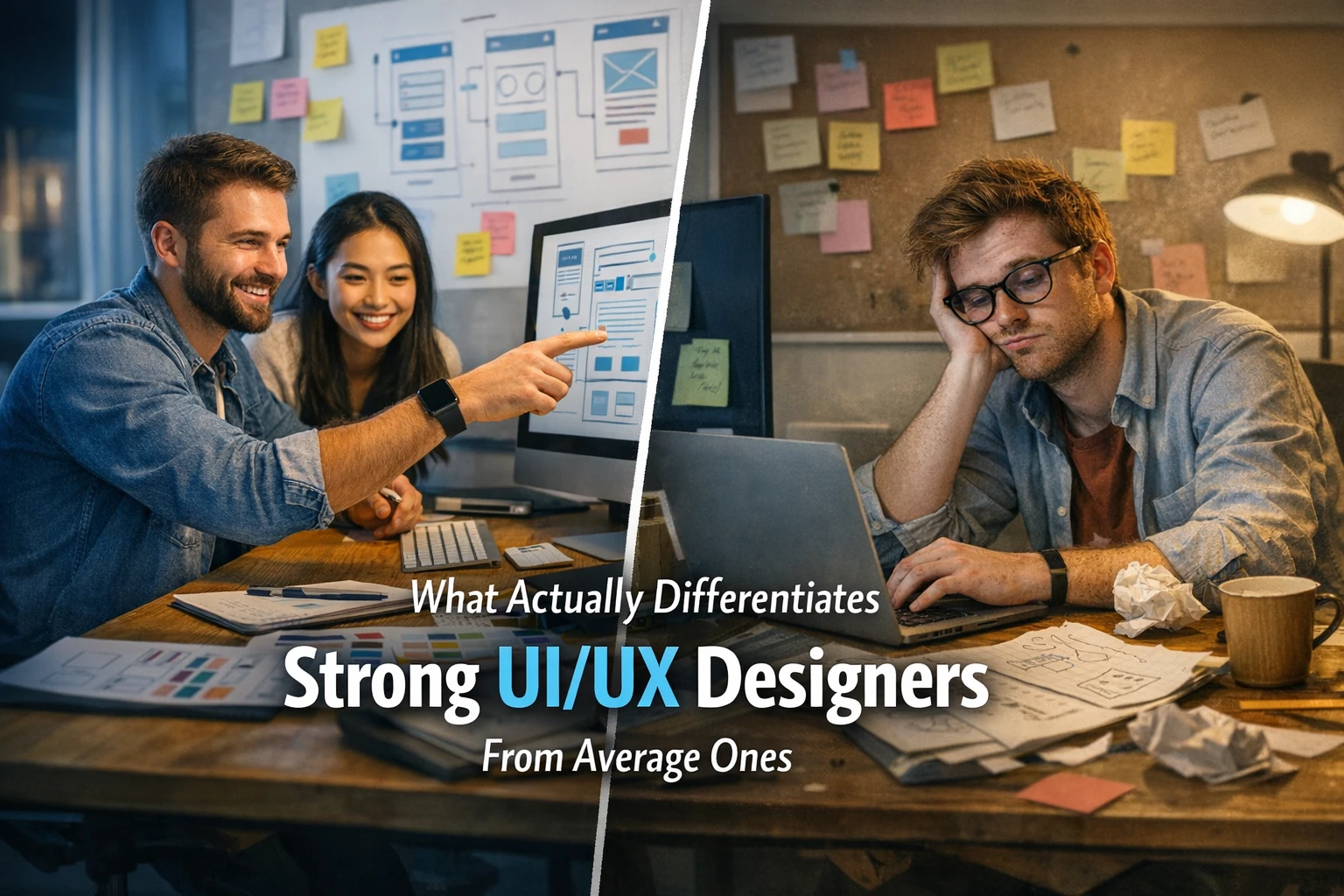
# What Actually Differentiates Strong UI/UX Designers From Average Ones
Most companies think they know what they’re hiring when they look for design support.
They expect cleaner screens. Better flows. Fewer usability complaints. Maybe an interface that finally feels “modern.”
But as organizations grow, especially in competitive environments like New York, the expectation shifts. The real difference between average and strong design talent becomes less about visual output and more about how decisions are made.
That’s when evaluating [UI UX designers](https://linkupst.com/design/blog-design/top-ui-ux-agencies) becomes less about portfolios and more about judgment.
### They Define the Problem Before Designing the Solution
Average designers respond to requests.\
Strong designers interrogate them.
When someone says, “We need to redesign onboarding,” the instinctive reaction is to sketch improvements. A more experienced designer pauses first. Why is onboarding underperforming? Where exactly is the friction? Is the issue comprehension, motivation, or product-market fit?
This isn’t obstruction. It’s discipline.
The most effective designers understand that interface changes cannot compensate for structural uncertainty. If the goal isn’t clear, design becomes cosmetic.
And cosmetic work rarely moves metrics in a durable way.
### They Make Trade-Offs Explicit
As products scale, simplicity becomes harder to maintain.
Features multiply. Edge cases expand. Stakeholders request visibility for their priorities. Every addition feels justified in isolation.
This is where strong design thinking becomes protective.
Rather than trying to satisfy every request, experienced designers surface trade-offs clearly:
* If we prioritize speed here, we may sacrifice flexibility.
* If we centralize controls, discoverability improves but customization becomes deeper.
* If we simplify too aggressively, advanced users may feel constrained.
The best partners don’t pretend these tensions disappear. They clarify them so leadership can decide consciously.
That clarity is one reason many companies move beyond freelance contributors and work with a seasoned [ui ux design agency ](https://linkupst.com/design)when complexity increases. Trade-offs at scale require structured reasoning, not just visual skill.
### They Think in Systems, Not Screens
It’s easy to evaluate individual screens. It’s harder to evaluate how a product behaves as a whole.
Strong designers look at patterns before pixels. They ask how new features integrate into existing flows. They examine how navigation scales as categories grow. They ensure that interaction rules remain consistent across contexts.
Without systems thinking, products drift. Inconsistencies accumulate slowly. Users adapt — until they don’t.
This systemic perspective is often what distinguishes top-tier talent within [best design consulting firms NYC](https://linkupst.com/design/blog-design/new-york-design-agencies). Their value lies not just in creating new interfaces, but in maintaining coherence over time.
### They Adapt Their Process Without Losing Structure
There’s no single perfect UX process.
Some projects demand rapid iteration. Others require careful research. Some need stakeholder alignment first. Others need concept exploration.
Less experienced teams follow process rigidly. Stronger teams understand when to adjust — without losing discipline.
They maintain checkpoints. They document decisions. They revisit assumptions when new data emerges.
Flexibility without structure creates chaos. Structure without flexibility creates stagnation.
The balance between the two is where maturity shows.
### They Understand Organizational Dynamics
Design rarely fails because of aesthetics. It fails because of misalignment.
Multiple stakeholders interpret goals differently. Engineering constraints appear late. Marketing priorities shift. Leadership introduces new directions mid-project.
Strong designers don’t ignore these realities. They navigate them.
They clarify ownership early. They surface disagreements before they harden. They reframe debates in terms of user outcomes rather than personal preferences.
In fast-paced markets like New York, this ability to manage organizational friction is often as valuable as design execution itself.
### They Design for Implementation, Not Presentation
Some concepts look impressive in a deck but unravel during development.
Mature designers anticipate constraints early. They collaborate with engineers before finalizing complex interactions. They differentiate between core experience elements that must remain intact and secondary details that can flex.
This foresight prevents expensive rework.
It also builds trust across teams. When developers see that design decisions account for feasibility, collaboration becomes smoother.
### They Measure Impact Beyond Launch Day
Strong designers don’t treat launch as the finish line.
They define measurable outcomes early. They identify which behaviors should shift and how those shifts will be tracked. They monitor whether improvements hold up over time.
Without measurement, design success becomes subjective.
With measurement, design becomes accountable.
And accountability elevates UX from decoration to strategy.
### They Reduce Cognitive Load — Internally and Externally
The ultimate test of strong design is not whether users notice it. It’s whether they don’t.
Interfaces should feel predictable. Flows should feel intuitive. Decisions should feel supported.
Internally, strong design also reduces cognitive load for teams. Clear systems simplify roadmap conversations. Documented rationale shortens debates. Structured patterns reduce duplication.
The impact compounds.
### Why Judgment Outweighs Style
In the end, what differentiates strong UI/UX designers isn’t boldness or creativity in isolation.
It’s judgment.
Judgment about what to prioritize.\
Judgment about what to simplify.\
Judgment about what to postpone.\
Judgment about when to challenge assumptions.
As products grow more complex, this judgment becomes more valuable than any individual visual decision.
And for leaders evaluating design partners, that’s the signal worth looking for.
Because screens can be redesigned.
But clarity — once embedded into how a team thinks — scales with the product.
---
# Agent Instructions: Querying This Documentation
If you need additional information that is not directly available in this page, you can query the documentation dynamically by asking a question.
Perform an HTTP GET request on the current page URL with the `ask` query parameter:
```
GET https://eztalks.gitbook.io/blog/growth/what-actually-differentiates-strong-ui-ux-designers-from-average-ones.md?ask=
```
The question should be specific, self-contained, and written in natural language.
The response will contain a direct answer to the question and relevant excerpts and sources from the documentation.
Use this mechanism when the answer is not explicitly present in the current page, you need clarification or additional context, or you want to retrieve related documentation sections.